


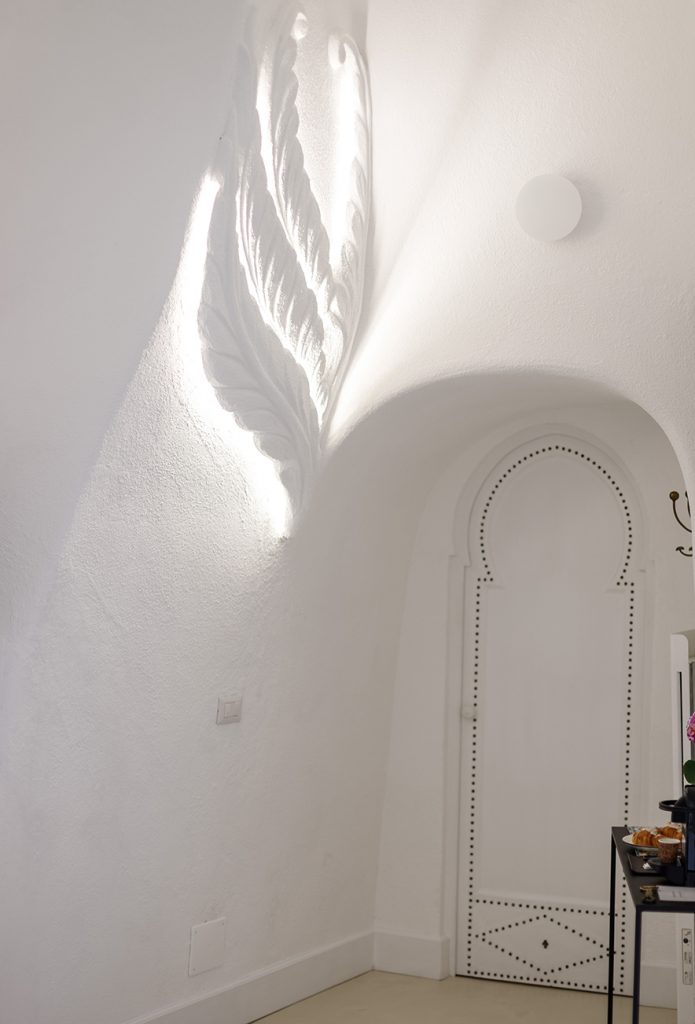
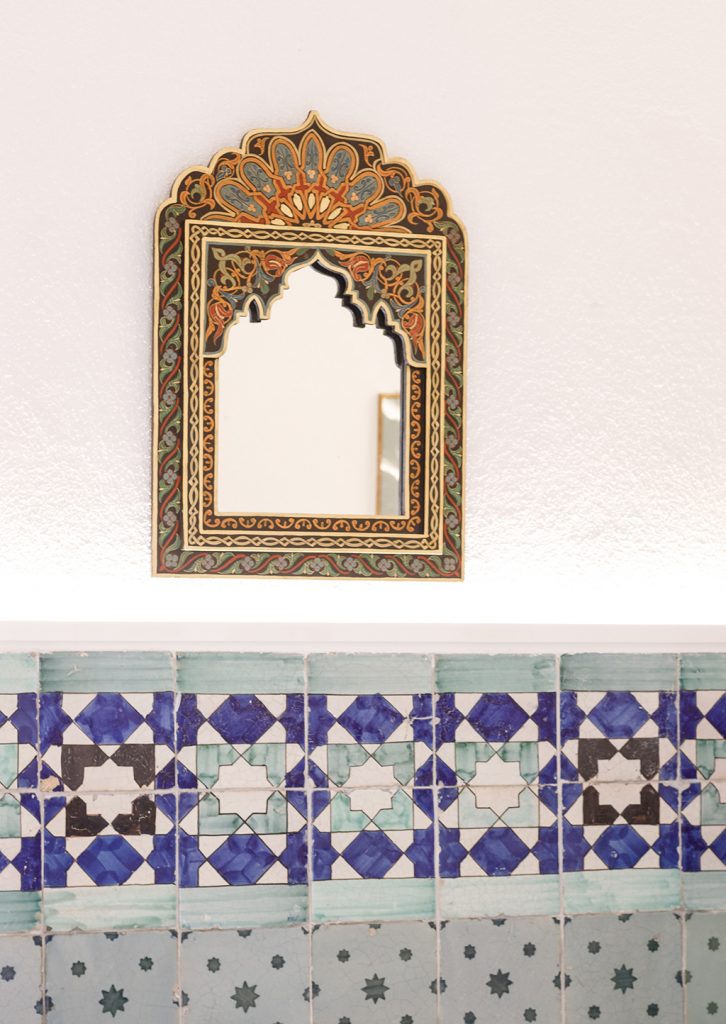
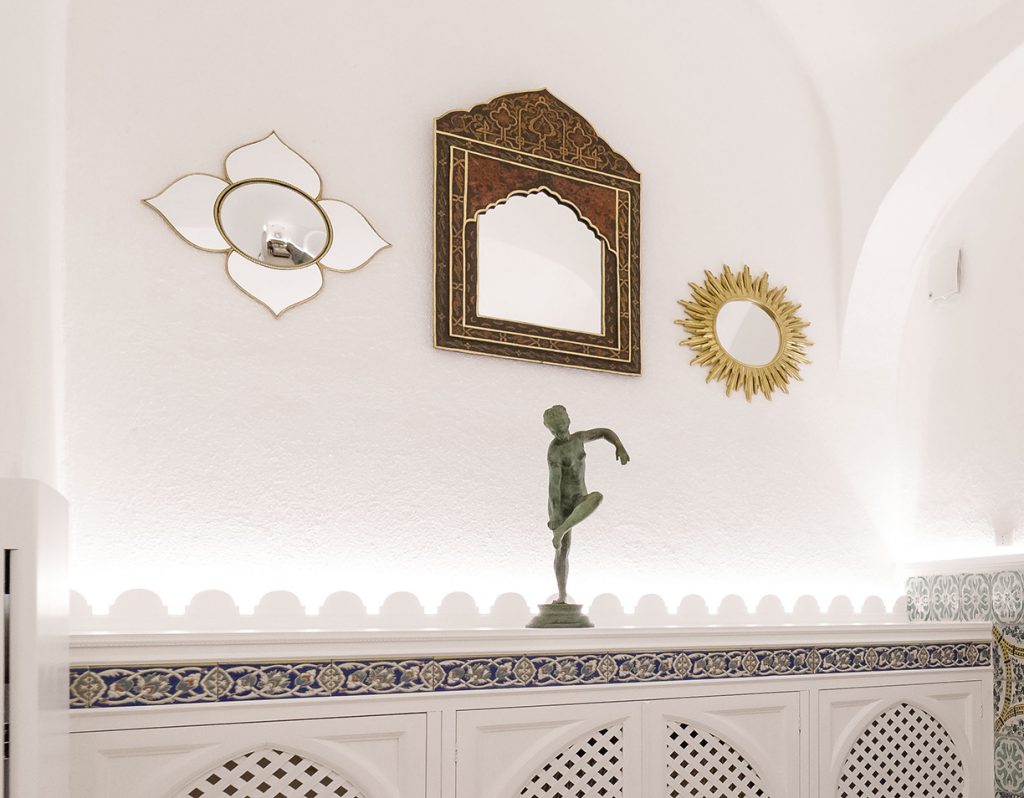
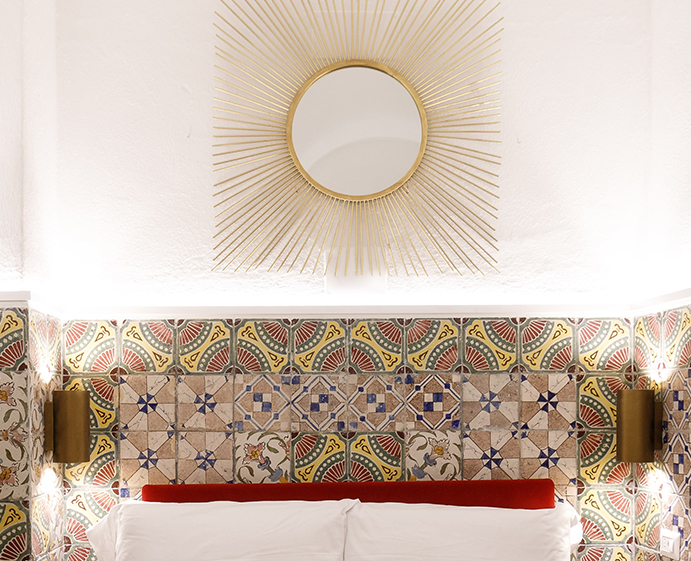
The oriental majolica covering and objects with oriental flavor, together with a lot of small precious details recreate a Mediterranean Moorish style, with a modern perspective to make your holiday in Capri an unforgettable one.
The peculiar décor style will take you in an evocative oriental atmosphere to live a romantic Arabian nights’ stay.
An oriental style: the reason why.
Ferdinand Gregorovius visited Capri in 1853 and wrote: “The Moorish style is both original and bizarre”.
The oriental fashion had been introduced in Capri since 1850 by that painters’ settlement who were “frankly unruly” – as Edwin Cerio described them – who were trying to give to the environment an Oriental character.
The Oriental Eclecticism dates back to the end of XIX century/beginning of the XX and it is the common thread of the story I am going to narrate.
In 1975 Yves Dupuis bought from Dana von Uexkull the small outbuilding of Villa Discopoli, named ‘La piccola Discopoli’or ‘Casina delle Rose’ which in 1906 hosted the famous poet Rainer Maria Rilke.
In the Eighties, Yves Dupuis also bought from Claretta Cerio a flat in Palazzo Farace, near the famous Piazzetta which is now our Luxury Suite. In 1997 with the authorization of the Superintendence, renovation works of the walls covered with antique majolica started.
In 2021 the whole space has been completely refurbished because it needed maintenance but it has been made without distorting the original scheme, regarding both the architectonical planning and the evocative oriental style message. Moreover, the lighting system which has been created has emphasized walls decoration and valuable furniture.
But where do this antique majolica come from?
The tiles were recovered – or better, saved – by Yves Dupuis during Villa Discopoli’s refurbishment works in the Eighties. The Villa was going to be transformed in an elegant flat complex. The majolica is still there as ornamental element of the Villa.
The frieze below the persepolitan merlon is the same of the one which adorn the living area; the same majolica was used for the frieze of Villa Helios given that probably the builder and/or the architect were the same and they could have entrusted the same workers.
The trend of adorning villas with neo-Moorish or neo–Ottoman majolica was a widespread one in Capri at the end of 19th and at the beginning of the 20th century. Villa Narcissus, owned by the painter Charles Caryl Coleman, was transformed with neo Moorish style in the same period and it was decorated with ceramic friezes which imitate the famous Irnik tiles. Villa Discopoli was one of the first oriental residences on the island, built in 1880. The structure shows a clear reference to Muslim mosque with a turret recalling a minaret, adorned with hand painted neo-Moorish and neo-Ottoman majolica, produced by prestigious Neapolitan factories.
The peculiarity, the beauty and the value of that majolica couldn’t slip from Yves Dupuis, his refined and elegant style, so he decided to recover them and cover the walls both of his Villa at Tragara and those ofthe flat at the Piazzetta, giving to the locations that Moorish taste which had been so fashion in Capri at the beginning of the century.
I like to think that the flat in Palazzo Farace, even though later refurbished, has a place in that oriental Eclecticism field which in Capri had its best expression in Villa Narcissus, Villa Discopoli, Villa Capricorno, Villa il Fortino, la Casa Rossa, Villa Quattro Venti, Villa La Torricella e Villa Helios.
Yves Dupuis was fascinated by the Arab world, he studied the language and travelled a lot, staying for long periods in Marocco where he bought a real estate, formerly a residence of the Mogador governor in Essaouira.
I believe that his aim was on one side to save that marvelous hand painted majolica made by important Neapolitan factories (on the back side it is possible to read the trademark: Delle Donne, Mattoni d’eccezione di Creso, Fabbrica Ricciardi), on the other transporting in that refuge, a very few steps far from the main square, in a Renaissance XV c. Palace, a tiny part of the Discopoli, a kind of an oriental throb in the heart of Capri.